A dog skin tag vs tumor question has a practical first answer: skin tags are soft, moveable, flesh-colored growths attached by a thin stalk, while tumors tend to be firmer, fixed to underlying tissue, and may grow faster. Knowing the difference at home can help you decide how urgently your dog needs a vet visit.
Finding a new lump on your dog triggers instant worry. Most growths are harmless, but some are not — and the physical clues you can observe right now will guide your next step.
What Is the Difference Between a Dog Skin Tag and a Tumor?
A dog skin tag is a benign overgrowth of skin cells, usually soft, flesh-colored, and hanging from a thin stalk. A tumor is an abnormal mass of tissue that can be benign or malignant, and it typically feels firmer and sits deeper in the skin than a tag.
- Skin tags move freely; tumors often feel anchored to tissue beneath.
- Skin tags are almost always skin-colored or slightly darker.
- Tumors may be red, ulcerated, or irregularly shaped.
- Skin tags grow very slowly; some tumors double in size within weeks.
- Skin tags rarely cause pain; tumors may cause sensitivity when touched.
- Age increases tumor risk — senior dogs over 7 years warrant closer monitoring.
Physical Signs You Can Check at Home
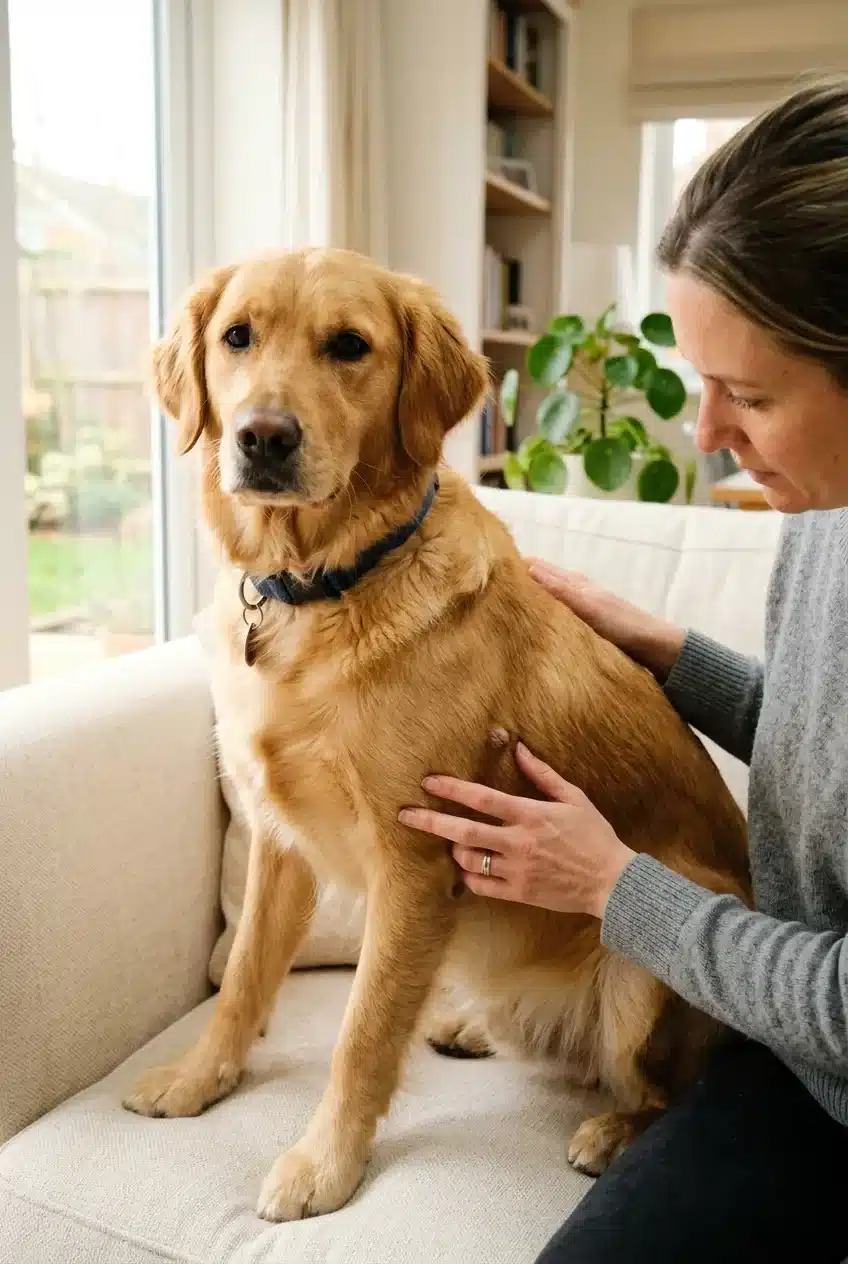
A hands-on check takes about two minutes and gives you the clearest picture before any vet visit. Use clean, dry hands and work in good lighting.
Texture and Movement
Gently press the growth between two fingers. A skin tag will feel soft — almost like a small piece of loose skin. It will wobble freely on its stalk.
A tumor tends to resist movement. If the mass feels rubbery, hard, or tethered to deeper tissue, that firmness is a red flag worth acting on quickly.
Rule of thumb: if you can pinch it and wiggle it easily, it behaves like a skin tag.
Shape and Borders
Skin tags have a smooth, regular outline. They look like a tiny teardrop or a small flap of skin.
Get Free Dog Health Tips!
Weekly guides on keeping your dog healthy & happy
🔒 No spam. Unsubscribe anytime.
Tumors — especially malignant ones — often have irregular borders. The edges may look jagged, raised unevenly, or blend into surrounding skin in an unpredictable way. If you notice any white or unusual papules growing on your dog’s skin, that pattern also warrants veterinary attention.
Color Changes
Normal skin tags stay close to your dog’s natural skin tone. They may darken slightly with age, but the color stays even.
MOST POPULAR THIS WEEK
Vet-Recommended Articles: 👇
👉 Why Does My Dogs Skin Turn Dark And Thick After Years Of Allergy Treatment
👉 Best Home Remedies For Arthritis In Dogs With Limping
👉 How Long Does An Elimination Diet Take For Dogs With Skin Allergies
Watch for red, purple, black, or multi-colored growths. Uneven pigmentation across a single mass is one of the clearest warning signs of a potentially cancerous lesion. Separately, if you are seeing broader dog skin turning black with age, that is a different condition worth investigating on its own.
Comparison: Skin Tag vs Tumor at a Glance
| Feature | Skin Tag | Tumor |
|---|---|---|
| Texture | Soft, pliable | Firm or hard |
| Movement | Moves freely on a stalk | Fixed or partially anchored |
| Shape | Smooth, regular | Irregular, lobulated |
| Color | Skin-toned, uniform | Variable, may ulcerate |
| Growth rate | Very slow | Can be rapid |
| Pain on touch | Rarely | Sometimes |
This table is a starting guide only. A veterinarian’s physical exam — and sometimes a fine-needle aspirate — is the only way to confirm what a growth actually is.
How to Do a Monthly Home Skin Check on Your Dog
Regular checks catch changes early. The American Veterinary Medical Association recommends owners become familiar with their pet’s normal body so that new lumps stand out immediately.
- Choose a calm moment — after a walk or feeding when your dog is relaxed.
- Run both hands slowly over the entire body, starting at the head and finishing at the tail base. Feel for any raised area, even under thick fur.
- Note the location of any growth you find. A quick photo next to a ruler gives you a size baseline to compare next month.
- Assess the three key traits: texture (soft vs. firm), movement (free vs. fixed), and color (uniform vs. uneven).
- Record your findings in a notes app with the date. Bring these notes to every vet visit.
- Book a vet appointment if any growth is new, growing, changing color, bleeding, or your dog is reacting to it with licking or biting.
A pet grooming magnifying lamp can make small or hard-to-see growths much easier to examine at home, especially on dogs with dark or dense coats.
When a Growth Needs a Vet — Not a Wait-and-See
Most skin tags are harmless and do not require removal. But certain signs mean you should book a vet appointment within days, not weeks.
“Any mass that changes size, shape, or color over a four-week period should be evaluated by a veterinarian. Early diagnosis significantly improves treatment outcomes.” — American Animal Hospital Association guidelines on tumor monitoring.
- The growth has doubled in size in less than a month.
- The surface is ulcerated, bleeding, or oozing.
- Your dog is scratching, licking, or biting at it constantly.
- The mass feels hard and does not move when pressed.
- Your dog is over 7 years old and the lump appeared suddenly.
- There are multiple new growths appearing at once.
Certain breeds carry higher tumor risk. Golden Retrievers, Boxers, and Bernese Mountain Dogs are documented by the American Veterinary Medical Association as having elevated cancer incidence compared to mixed-breed dogs.
If skin irritation is contributing to growths or discomfort, using a hypoallergenic dog shampoo for sensitive skin during routine baths can reduce inflammation around the area. Also consider whether grass or outdoor allergens are aggravating your dog’s skin and creating secondary irritation near existing growths.
Common Mistakes Dog Owners Make With Skin Growths
- Assuming all lumps are harmless tags. The consequence: a malignant tumor goes undiagnosed until it spreads. Fix: check every new growth against the comparison table above and see a vet if any red-flag trait appears.
- Trying to remove a skin tag at home. The consequence: infection, scarring, or accidental removal of something that needed a biopsy. Fix: leave removal to your veterinarian, even for confirmed tags.
- Waiting months before acting on a change. The consequence: a slow-growing tumor becomes significantly harder to treat. Fix: photograph the growth on day one and compare every two weeks.
- Ignoring growths on the mouth, paws, or between toes. The consequence: these areas have higher rates of malignant tumors and are easy to miss. Fix: include paws and gum lines in every monthly check. Using a small inspection light for dog paws helps spot hard-to-see masses in skin folds.
- Skipping the vet because the dog seems fine. The consequence: dogs mask pain well, so normal behavior does not rule out a serious growth. Fix: base the decision on the growth’s physical traits, not your dog’s mood.
Frequently Asked Questions About Dog Skin Tag vs Tumor: How to Tell the Difference at Home
Can a skin tag on a dog turn into cancer?
Skin tags themselves do not turn cancerous. However, what looks like a skin tag could already be a benign or malignant tumor — which is exactly why any new growth should be assessed by a vet if it shows firm texture or irregular color.
How fast do dog skin tags grow compared to tumors?
Dog skin tags grow very slowly, often staying the same size for years. Malignant tumors can double in size within weeks, so rapid growth is one of the clearest signals that a lump needs immediate veterinary evaluation.
Should I be worried about a soft lump on my dog?
A soft, freely moving lump is more likely to be a skin tag or lipoma than a malignant tumor. That said, softness alone does not confirm safety — a vet exam is the only way to rule out anything serious.
What does a mast cell tumor look like on a dog?
A mast cell tumor often looks like a raised, reddish lump that can change size over hours. The American Kennel Club Canine Health Foundation notes they are one of the most common skin tumors in dogs and require urgent biopsy.
Can I use a photo to track if a dog skin tag is growing?
Yes — photographing the growth next to a ruler every two weeks is an effective way to detect size changes early. Bring these dated photos to your vet to help them assess the rate of growth accurately.
Do skin tags on dogs need to be removed?
Dog skin tags only need removal if they bleed regularly, become infected, or interfere with movement or vision. A vet may recommend removal if the tag is in a high-friction area like an armpit or collar line.
The One Thing to Do After Reading This
When it comes to dog skin tag vs tumor concerns, the single most useful action is to start a simple photo log today. Take a dated photo of every existing growth your dog has, note its size and texture, and check again in two weeks.
If anything changes — size, color, firmness, or your dog’s reaction to it — book a vet appointment without delay. Early evaluation is always cheaper and more effective than late-stage treatment.
Keeping your dog’s skin healthy overall also matters. Explore the best skin-soothing dog shampoos to support coat and skin condition between checkups. And if stress is affecting your dog’s wellbeing more broadly, guidance on helping an anxious dog settle at home can make a real difference to their overall health.