Potty training a standard poodle puppy typically takes 4 to 8 weeks with consistent daily effort. Some puppies reach reliable house training closer to 3 to 4 months, depending on when you start and how consistent your routine is.
If you just brought home a new standard poodle pup, you are probably wondering whether you are looking at weeks or months of accidents. The answer depends on a few key factors — age, schedule, and your response to mistakes.
How Long Does Potty Training a Standard Poodle Puppy Actually Take?
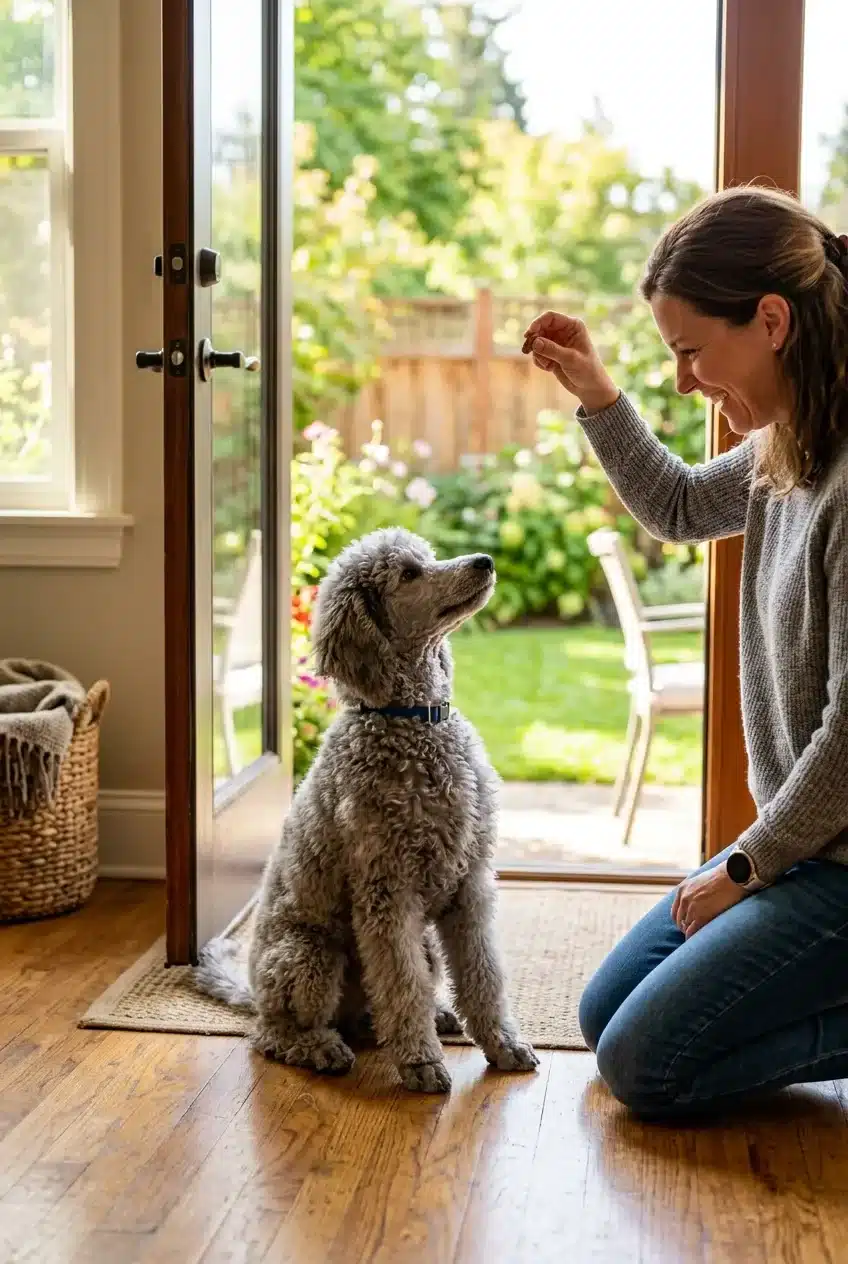
Most standard poodle puppies achieve basic potty training within 4 to 8 weeks of starting a consistent routine. Full reliability — meaning fewer than one accident per week — usually comes between 3 and 6 months of age, once bladder control matures.
- Average training window: 4–8 weeks with a strict schedule
- Full bladder control develops around 4–6 months of age
- Standard poodles rank among the most trainable breeds, per the American Kennel Club
- Puppies under 12 weeks cannot physically hold their bladder for more than 1–2 hours
- Consistency beats intensity — short, frequent trips outperform long, infrequent ones
- Regression is normal between 4 and 6 months during the adolescent phase
Why Standard Poodles Learn Faster Than Many Other Breeds
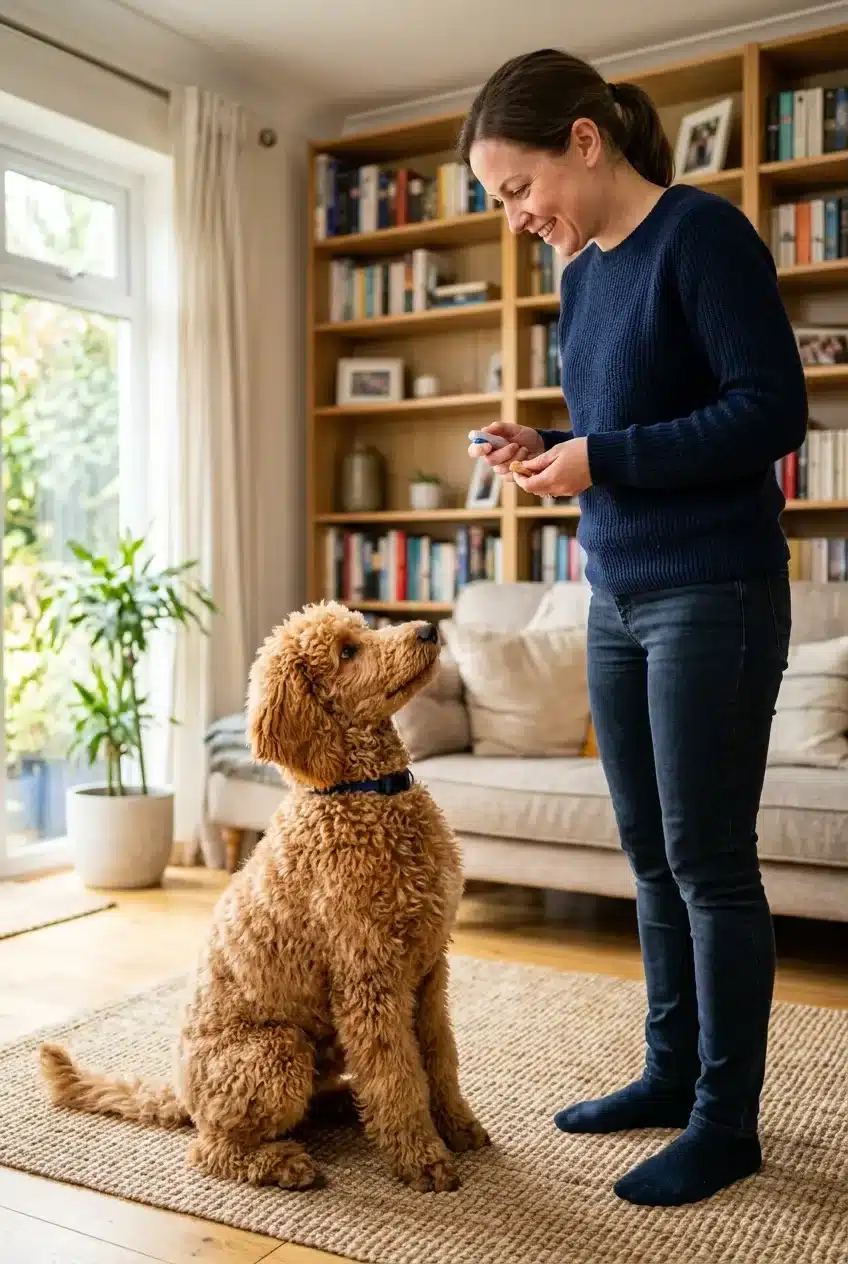
Standard poodles consistently rank in the top tier of dog intelligence. Stanley Coren’s The Intelligence of Dogs (1994, University of Washington) places poodles second overall for working and obedience intelligence — behind only the border collie.
That ranking matters for house training. A smarter dog makes associations between location, reward, and behavior more quickly.
The American Kennel Club describes standard poodles as “exceptionally smart” and notes they respond readily to positive reinforcement, making them one of the easier large breeds to house train.
Still, intelligence does not replace a consistent schedule. A brilliant puppy with an unpredictable owner will take just as long as an average puppy.
High intelligence speeds up learning, but it also means a bored poodle will test boundaries more creatively.
Get Free Dog Health Tips!
Weekly guides on keeping your dog healthy & happy
🔒 No spam. Unsubscribe anytime.
Age vs. Training Timeline: What the Numbers Actually Show

Your puppy’s age at the start of training directly affects how long the process takes. Younger puppies learn habits faster, but their bodies set the ceiling on what is physically possible.
Bladder Capacity by Age
| Age | Max Hold Time (Awake) | Expected Accidents Per Day |
|---|---|---|
| 8 weeks | 1–2 hours | 6–8 |
| 10 weeks | 2 hours | 4–6 |
| 12 weeks | 2–3 hours | 3–5 |
| 16 weeks | 3–4 hours | 1–3 |
| 6 months | 4–6 hours | 0–1 |
A general rule used by veterinary behaviorists: puppies can hold their bladder for roughly one hour per month of age, plus one. So a 3-month-old poodle can manage about 4 hours maximum — and less during active play.
Understanding how long a puppy can hold their bladder in a crate helps you set a schedule that matches your pup’s physical limits, not just your convenience.
DON’T MISS THESE
Paw-pular Reads: 👇
👉 How Many Puppies Can Poodle Have
👉 How Long Is A Poodle Pregnant
Starting Age and Typical Completion Time
Puppies who begin training at 8 weeks tend to be fully reliable by 4 months. Those who start at 12 weeks often reach that same milestone around 5 to 6 months — the habit window is narrower early on.
The Step-by-Step Potty Training Process for a Standard Poodle Puppy
A structured process cuts weeks off your training timeline. Follow these steps in order from day one.
- Set a fixed bathroom schedule. Take your puppy outside first thing in the morning, after every meal, after naps, after play, and before bed. For an 8-week-old, that means 8 to 10 trips per day.
- Pick one outdoor spot and use it every time. The scent triggers the elimination reflex. Lead your puppy to the same patch of grass each trip.
- Use a consistent cue word. Say “go potty” or your chosen phrase calmly as they squat. Over time, this phrase becomes a reliable prompt.
- Reward within 3 seconds of finishing. Use a small, high-value treat — a soft puppy training treat works well because it can be consumed instantly without distraction.
- Supervise indoors at all times. Tether your puppy to you with a leash or use a playpen. If you cannot watch, crate them.
- Respond to accidents neutrally. Clean with an enzymatic cleaner immediately. No scolding — it only teaches fear, not location.
- Extend freedom gradually. Only give unsupervised indoor access after 4 to 6 consecutive accident-free weeks.
If outdoor access is limited, training your puppy to use a fake grass potty area indoors can bridge the gap while building the same location-based habit.
Factors That Slow Down Potty Training
Several conditions can stretch a 6-week timeline into 4 to 6 months. Knowing them in advance means you can remove obstacles before they compound.
Inconsistent Scheduling
Varying trip times by more than 30 minutes confuses the puppy’s internal clock. Dogs develop strong circadian bathroom rhythms — disrupting them resets learning.
Previous Bad Habits From the Breeder or Shelter
Puppies kept in small, soiled enclosures learn to eliminate where they sleep. This directly conflicts with the crate training instinct and can add 4 to 8 weeks to your timeline.
Medical Issues
Urinary tract infections (UTIs) in puppies cause sudden, uncontrollable urination. According to the American Veterinary Medical Association (AVMA), UTIs are common in female puppies and easily mistaken for training failure.
If a previously improving puppy suddenly regresses, a vet visit rules out infection before you change your training approach.
Owner Responses to Accidents
- Scolding after the fact: puppies cannot connect punishment to an act that happened minutes ago
- Using ammonia-based cleaners: they smell like urine to a dog and invite re-soiling
- Giving too much indoor freedom too soon: unsupervised time leads to hidden accidents that reset location habits
Common Potty Training Mistakes and How to Fix Them
- Waiting too long between trips. A puppy forced to hold it past their limit has an accident — then learns the floor is acceptable. Fix: Use the age-plus-one formula to set your maximum interval.
- Rewarding too late. Treats given 10 seconds after elimination lose their connection to the act. Fix: Keep treats in your pocket every trip so you can reward within 3 seconds.
- Using punishment for indoor accidents. This creates anxiety, which increases accidents. Fix: Interrupt with a calm “outside” and move the puppy — never scold after the fact.
- Skipping crate training. Without a crate, unsupervised time leads to accidents that undo progress. A properly sized large dog crate for standard poodles uses their denning instinct to prevent accidents.
- Declaring success too early. Two clean weeks does not mean training is complete. Accidents return when routine changes. Fix: Maintain the schedule for at least 4 clean weeks before relaxing supervision.
Building on the timeline section above, consistency across all household members matters as much as your personal routine. One family member who skips trips or ignores accidents can double your total training time.
What Full Potty Training Actually Looks Like
A fully potty-trained standard poodle puppy will signal reliably — sitting by the door, whining, or circling — before eliminating. This signaling behavior typically emerges between 4 and 6 months when combined with consistent training from 8 weeks.
At that point, your poodle should have zero accidents during the day and none overnight if crated. Occasional accidents during high excitement (greetings, play) can persist until 7 to 9 months as emotional regulation matures.
The standard poodle puppy’s development stages also affect when certain skills lock in — so matching your expectations to developmental milestones reduces frustration.
Target milestone: zero accidents for 30 consecutive days before considering your puppy fully trained.
Frequently Asked Questions About How Long Does Potty Training Actually Take for a Standard Poodle Puppy
Can a standard poodle puppy be potty trained in 2 weeks?
Two weeks of consistent training builds a strong foundation, but full potty training for a standard poodle puppy typically takes 4 to 8 weeks. Bladder control is the limiting factor, not intelligence.
Is it harder to potty train a male or female standard poodle?
Male standard poodles may take slightly longer due to marking instincts that emerge around 4 to 6 months. Neutering before that window reduces but does not eliminate this tendency.
Should I use puppy pads with a standard poodle?
Puppy pads teach a puppy that indoor elimination is acceptable, which can extend the outdoor training timeline by 4 to 8 weeks. Use them only if outdoor access is genuinely limited.
How do I know if my standard poodle puppy is ready for unsupervised indoor time?
Your puppy is ready for limited unsupervised time after 4 to 6 consecutive accident-free weeks and once they reliably signal at the door before needing to go outside.
Why is my standard poodle regressing after doing so well?
Regression between 4 and 7 months is common during adolescence, when hormone surges temporarily affect impulse control. Return to the original schedule and supervision level for 2 to 3 weeks.
Does crate size affect how quickly a standard poodle puppy learns?
Yes. A crate that is too large allows the puppy to eliminate in one corner and sleep in another. The crate should be just large enough for the puppy to stand, turn, and lie down comfortably.
The Bottom Line on Standard Poodle Potty Training
Potty training a standard poodle puppy realistically takes 4 to 8 weeks to establish strong habits and up to 6 months for full, reliable bladder control. Their intelligence gives them an edge, but only if you give them a consistent schedule to work with.
The single most effective action you can take today: write out a fixed daily schedule with trip times every 1.5 to 2 hours and post it somewhere visible. A schedule on paper becomes a schedule in practice.
For more guidance on poodle development, the American Kennel Club’s standard poodle breed page covers behavioral traits that affect training. The AVMA’s pet care resources offer veterinary-backed guidance on puppy health that underpins training success.
If you are working with a particularly headstrong pup, the strategies in potty training a stubborn puppy fast translate well across breeds and can shorten your timeline considerably.