To stop your dog from barking in the crate when you leave, you need to address separation anxiety, incomplete crate training, or pent-up energy — often all three at once. Most dogs bark because the crate feels like punishment, not a safe space.
If you are struggling with this right now, you are not alone. Crate barking is one of the most searched dog behavior problems, and it has practical, proven solutions. Here is exactly how to fix it.
How Do I Stop My Dog From Barking in the Crate When I Leave?
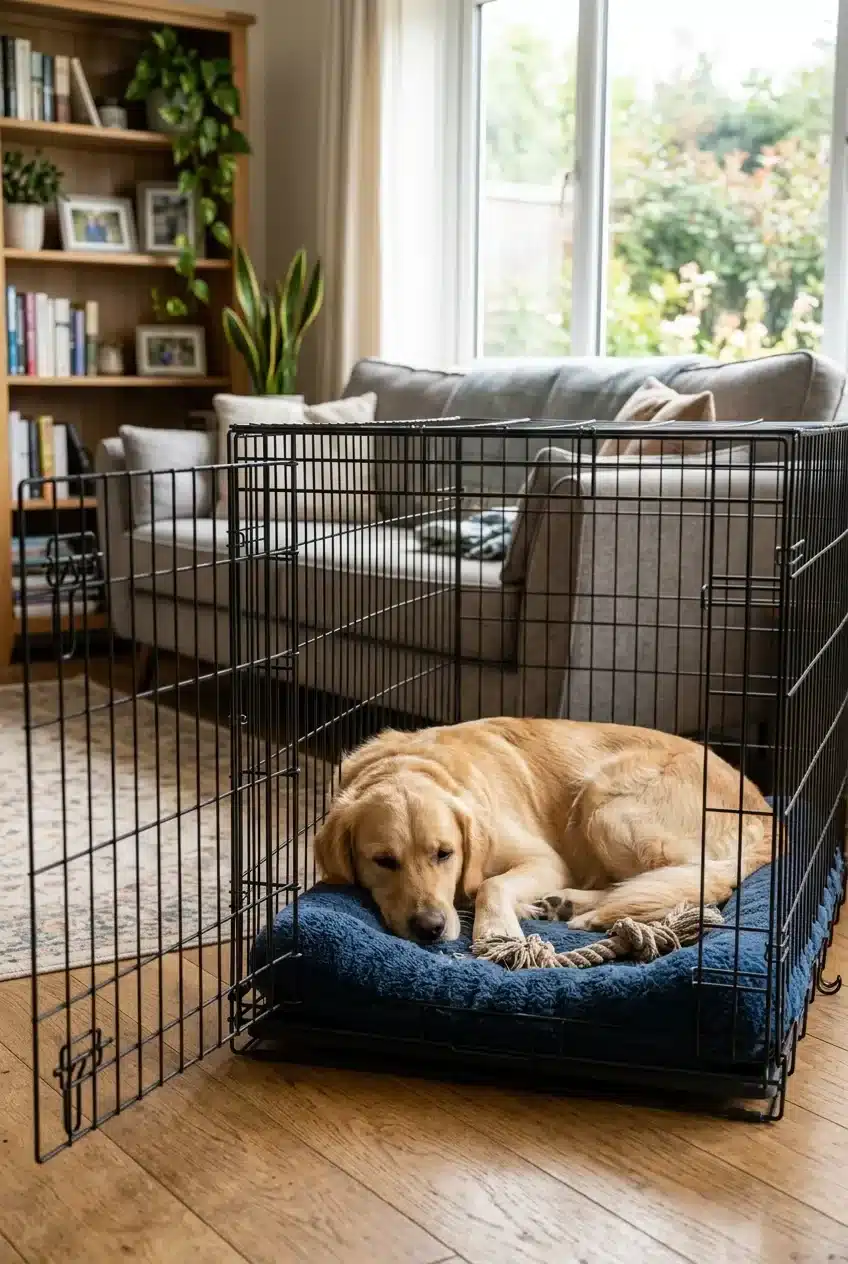
Stop your dog from barking in the crate when you leave by building a positive crate association through gradual desensitization, meeting exercise needs before crating, and never releasing your dog while barking. Consistency across every departure matters more than any single trick.
- Exercise your dog 30–60 minutes before crating to reduce energy-driven barking.
- Feed meals inside the crate so your dog links it with good things.
- Practice short absences first — 2 minutes before building to longer ones.
- Cover three sides of the crate with a dog crate cover to reduce visual stimulation.
- Never return or give attention while your dog is still barking.
- Use a long-lasting chew or puzzle toy to occupy your dog at departure.
Why Does Your Dog Bark in the Crate When You Leave?
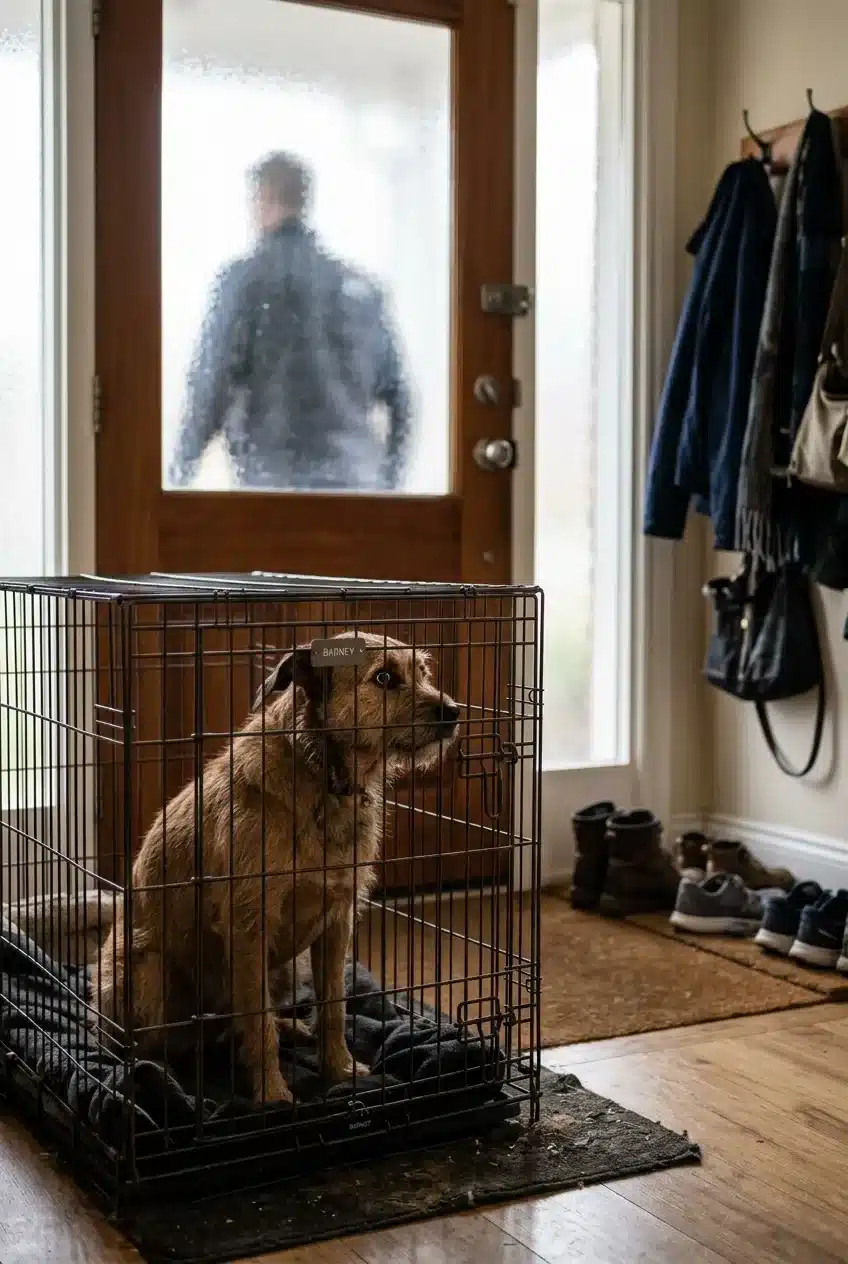
Dogs bark in the crate when you leave for one of three core reasons: incomplete crate training, separation-related distress, or insufficient physical and mental stimulation. Identifying the right cause points you to the right fix.
Separation Anxiety vs. Normal Protest Barking
These two are often confused, but they respond to very different approaches. The American Veterinary Medical Association describes separation anxiety as a condition where the dog shows distress behaviors — barking, panting, pacing, or destruction — specifically triggered by the owner’s absence.
Normal protest barking usually stops within 10–15 minutes as the dog settles. Separation anxiety barking escalates or continues for the full absence.
Setting up a camera to record your dog after you leave is the fastest way to tell the difference. If the barking never stops or the dog appears panicked, consult a veterinary behaviorist rather than relying on home training alone.
Prolonged barking can also affect your household — and if neighbors or family members are nearby, it is worth knowing that dog barking can hurt your ears with repeated close-range exposure.
Get Free Dog Health Tips!
Weekly guides on keeping your dog healthy & happy
🔒 No spam. Unsubscribe anytime.
The Crate Feels Like Isolation, Not Safety
Many dogs were crated abruptly without a gradual introduction. When that happens, the crate becomes associated with being abandoned rather than resting.
A crate should feel like your dog’s bedroom — not a holding cell.
DON’T MISS THESE
Paw-pular Reads: 👇
👉 How Many Puppies Can Poodle Have
👉 How Long Is A Poodle Pregnant
Dogs with this association need a structured re-introduction process, which is covered in the step-by-step section below. Skipping that process and just leaving longer will usually make barking worse, not better.
How to Crate Train a Dog That Already Barks When Left Alone
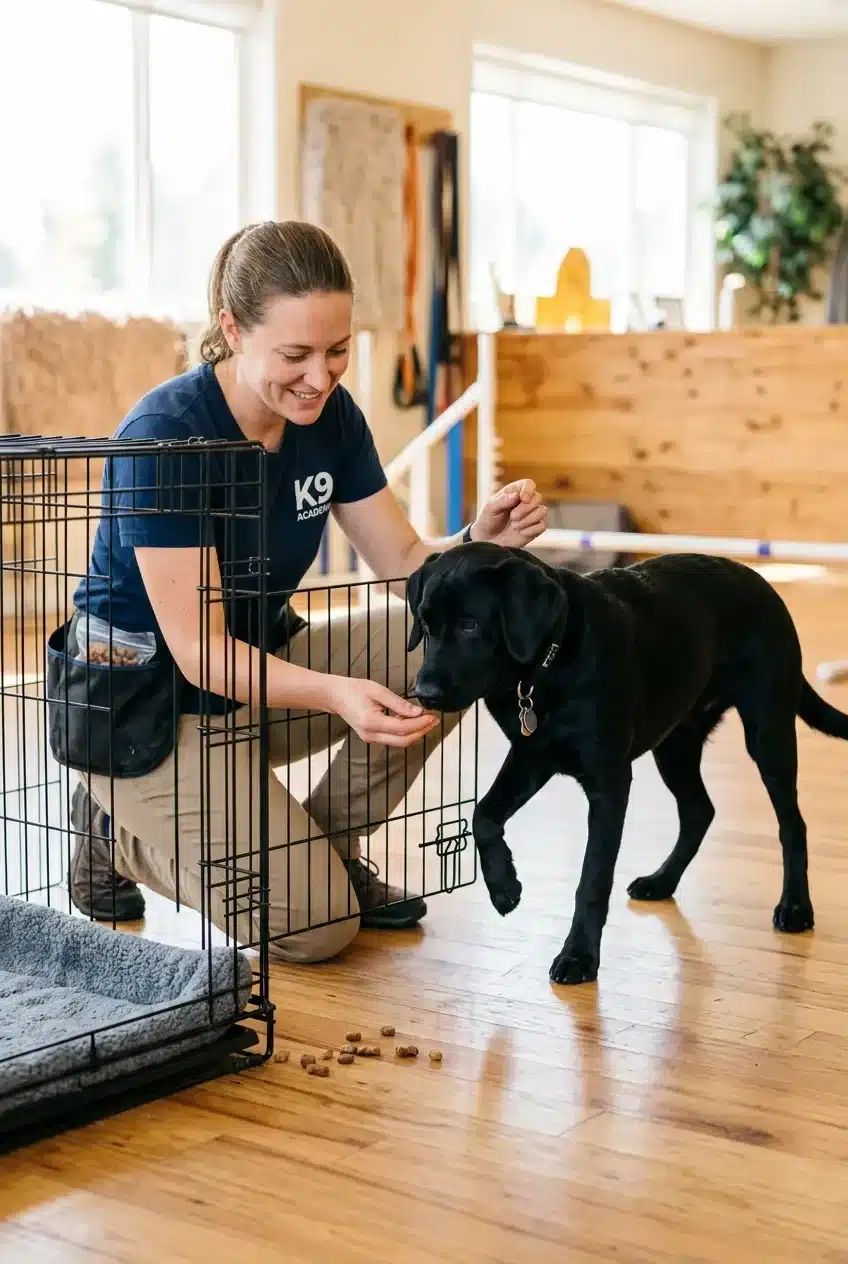
Re-training a dog that already barks requires a reset — going back to the beginning of crate training even if your dog has used a crate for months. The goal is to rebuild the emotional response to being inside the crate.
- Place the crate in a social area. Put it where your dog naturally rests, not in an isolated room. Dogs are less distressed when they can sense household activity.
- Feed every meal inside the crate with the door open for the first three days. Do not close the door yet. Let the dog choose to enter.
- Introduce a crate-only reward. Use a high-value treat like a frozen KONG stuffed with peanut butter that your dog gets only when in the crate. This creates a strong positive link.
- Close the door for 30 seconds while you stay visible. Gradually extend to 2 minutes, then 5 minutes, over several sessions across a few days.
- Leave the room briefly once your dog is calm at 5 minutes with the door closed. Step out for 30 seconds, return calmly, and ignore the dog until calm.
- Build to full departures slowly. Increase absence duration in small increments — 5 minutes, 10 minutes, 20 minutes — only moving forward when the previous duration is quiet.
- Keep departures low-key. No long goodbyes. Drawn-out farewells actually increase anxiety by signaling that leaving is a big event.
According to the American Society for the Prevention of Cruelty to Animals (ASPCA), dogs typically need several weeks of gradual desensitization to show lasting improvement with separation-related barking.
How Exercise and Mental Stimulation Reduce Crate Barking
A physically tired and mentally satisfied dog settles far faster in a crate. Energy-driven barking is one of the most common — and most fixable — causes of crate noise.
“A dog that has not had adequate exercise is much more likely to vocalize and struggle to settle in a confined space.” — Karen Overall, MA, VMD, PhD, board-certified veterinary behaviorist
The general guideline from most veterinary behavior resources is 30–60 minutes of moderate aerobic exercise before any crating period. For high-energy breeds like Border Collies, Huskies, or Vizslas, that floor is closer to 60–90 minutes.
Mental exercise counts too. A 15-minute training session or a sniff walk tires a dog faster than a brisk jog around the block. Pair physical and mental activity for the best pre-crate routine.
If your dog also scratches at the crate at night, the root cause is often the same — under-stimulation paired with anxiety. Solving both starts with the exercise foundation.
What to Put in the Crate to Help Your Dog Relax
The right environment inside the crate reduces arousal and gives your dog something to focus on other than your absence. These additions make a measurable difference.
| Item | What It Does | Best For |
|---|---|---|
| Frozen stuffed KONG | Occupies focus at departure | All dogs |
| Worn T-shirt (yours) | Provides scent comfort | Anxious dogs |
| White noise machine | Masks triggering outdoor sounds | Sound-reactive dogs |
| Crate cover | Reduces visual stimuli | Visually excitable dogs |
| Calming chew or treat | Mild relaxation support | Mildly anxious dogs |
Placing a worn item of your clothing in the crate is backed by research. A 2019 study published in Learning and Behavior found that a familiar owner scent reduced stress indicators in shelter dogs, suggesting the same mechanism applies in home settings.
A white noise machine near the crate is especially useful in busy households or apartments where street sounds trigger reactive barking.
Common Mistakes That Make Crate Barking Worse
Several well-meaning responses actually reinforce the barking or deepen anxiety. Avoiding these speeds up your results significantly.
- Returning when your dog barks: This teaches barking as an effective exit strategy. Wait for even 3 seconds of quiet before re-entering. Returning to quiet behavior is the rule.
- Rushing the training timeline: Moving from 5-minute to 4-hour absences too quickly causes setbacks that take weeks to undo. Build duration in small, successful steps.
- Using the crate as punishment: Sending a dog to the crate after bad behavior makes the crate feel threatening. The crate must always signal neutral-to-positive experiences.
- Crating a dog that needs veterinary help: True separation anxiety requires medication support alongside behavioral training in many cases. Behavioral modification alone has lower success rates for clinical anxiety, according to the ASPCA.
- Skipping pre-departure exercise: Placing a high-energy dog directly into a crate after hours of inactivity sets the dog up to fail, no matter how well the crate is set up.
If you have recently brought a new dog home, managing alone time carefully is especially important. Read about whether it is safe to leave a newly adopted dog home alone before establishing a crating routine.
Puppies have their own specific crating challenges. If you are also dealing with nighttime accidents, the guide on why young puppies pee in the crate overnight covers the behavioral and physiological reasons behind it.
For a full evidence-based overview of separation anxiety diagnosis and treatment, the ASPCA’s separation anxiety resource is a reliable starting point before deciding whether professional help is needed.
Frequently Asked Questions About How to Stop Dog From Barking in Crate When I Leave
How long does it take to stop a dog from barking in the crate?
Most dogs show significant improvement within two to four weeks of consistent desensitization training. Dogs with clinical separation anxiety may need eight to twelve weeks, especially when medication is also involved.
Should I ignore my dog barking in the crate?
Ignore barking that is protest-based — returning to barking rewards it. However, do not ignore signs of genuine panic like self-injury or inability to breathe normally, which require veterinary assessment rather than behavioral waiting.
Is it cruel to crate a dog while at work?
Crating a dog for up to four to five hours at a time is generally accepted as appropriate when the dog is properly trained and exercised beforehand. Longer durations require a midday break from a dog walker or sitter.
Why does my dog only bark in the crate when I leave, not for others?
Dogs bark specifically at your departure because they have formed a primary attachment bond with you. This is called owner-specific separation anxiety and responds to the same desensitization methods, though it may take longer.
Can I use a bark collar to stop crate barking?
Bark collars are not recommended for separation anxiety or fear-based barking. Punishing the bark suppresses the symptom without addressing the underlying distress, and may increase anxiety according to the American Veterinary Society of Animal Behavior.
At what age do dogs stop barking in the crate?
There is no fixed age — barking in the crate is a trained behavior, not a developmental phase. Dogs of any age stop crate barking when the crate association becomes reliably positive and departure anxiety is properly reduced.
The Single Most Important Step to Take Today
The fastest way to stop your dog from barking in the crate when you leave is to go back to basics: reintroduce the crate as a positive space, exercise before every crating session, and never re-enter while barking is happening.
Start today by feeding your dog’s next meal inside the crate with the door open. That one action begins rebuilding the emotional association that makes everything else work.
Consistency is what separates dogs that improve in two weeks from those still barking six months later. Pick a method, follow the steps, and stick to them — your dog will get there.