To stop a puppy from chewing furniture when you’re not home, combine confinement, appropriate chew toys, and bitter-tasting deterrent sprays before you leave. These three steps address the root causes — boredom, teething discomfort, and unsupervised access — without punishment.
Most owners search for this answer after coming home to a gnawed chair leg or shredded sofa corner. The good news is that consistent management started early prevents most furniture damage permanently.
How Do You Stop a Puppy From Chewing Furniture When You’re Not Home?

The most effective way to stop a puppy from chewing furniture when you’re not home is to remove access to furniture through crating or puppy-proofing, provide safe chew alternatives, and apply a deterrent spray to exposed wood or upholstery before leaving.
- Crate or pen your puppy to limit unsupervised access to furniture.
- Leave at least two approved chew toys every time you go out.
- Apply a pet-safe bitter apple spray to furniture legs and cushion edges.
- Exercise your puppy before leaving — tired puppies chew less.
- Increase alone time gradually to reduce separation anxiety chewing.
- Never correct a puppy after the fact — they cannot link punishment to a past act.
Why Puppies Chew Furniture — and Why It Gets Worse When You Leave

Puppies chew for three main reasons: teething pain (most intense between 3 and 6 months), boredom from under-stimulation, and anxiety triggered by being alone. Understanding which driver applies to your puppy changes the solution.
The American Kennel Club notes that chewing is a completely normal puppy behaviour. The problem is not the chewing itself — it is the target.
Destructive chewing in puppies is almost always a management failure, not a training failure. Removing access to the wrong items is the first line of defence. — American Kennel Club, Puppy Behaviour Resources
Anxiety-driven chewing tends to start within the first 20–30 minutes after you leave. Boredom chewing usually begins later, once a puppy has exhausted its initial energy.
Knowing the difference helps you choose the right fix — confinement for boredom, gradual departures for anxiety.
Get Free Dog Health Tips!
Weekly guides on keeping your dog healthy & happy
🔒 No spam. Unsubscribe anytime.
Teething vs. Anxiety Chewing
| Type | When It Happens | What Helps Most |
|---|---|---|
| Teething | 3–6 months old | Cold chew toys, frozen treats |
| Boredom | Any age, after energy peak | Exercise before leaving, puzzle toys |
| Anxiety | First 20–30 min alone | Gradual departures, calming aids |
Setting Up the Right Confinement Space
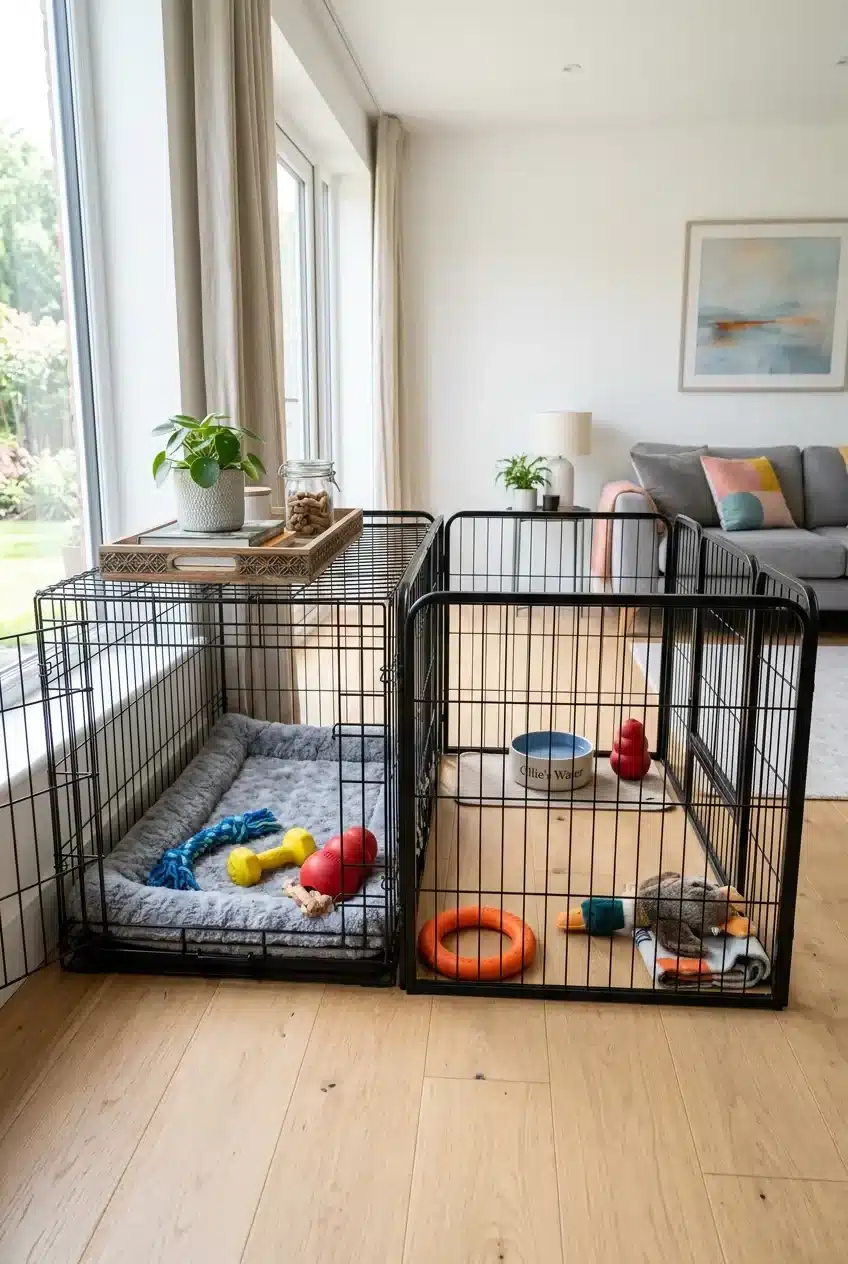
Confinement is the single most reliable way to protect furniture when you cannot supervise your puppy. A crate or exercise pen removes access entirely — no access means no damage.
Choose a well-sized puppy crate where your dog can stand, turn around, and lie down comfortably. Too much space invites toileting in one corner and chewing in another.
- Line the crate with a chew-resistant mat, not loose bedding a young puppy can destroy.
- Place the crate in a low-traffic but not isolated area — complete isolation raises anxiety.
- Practice crate training while home first so the space feels safe before you leave.
If a full crate feels too restrictive for longer absences, a puppy pen or a puppy-proofed room works well. Remove or cover furniture legs with cord protectors or furniture covers before closing the door.
Puppy-Proofing a Room
If you use a room rather than a crate, do a floor-level audit before leaving. Get down to puppy height and look for exposed wood legs, dangling cables, and soft upholstery edges.
Wrapping exposed wooden furniture legs in chew-deterrent furniture protectors gives a physical barrier that lasts longer than spray alone.
Choosing the Right Chew Toys and Deterrents
The right chew toys redirect natural chewing instincts onto acceptable targets. A puppy left with nothing to chew will always find something — usually your furniture.
The ASPCA’s general dog care guidelines recommend rotating toys regularly so they stay novel. Novelty matters because puppies lose interest in familiar objects quickly.
- Rubber chew toys (e.g., hollow stuffable toys) keep puppies occupied for extended periods.
- Frozen chew items — a stuffed rubber toy frozen overnight — also soothe teething gums.
- Nylon chew bones are long-lasting and safe for unsupervised chewing.
- Avoid rawhide or small squeaker toys left unsupervised due to choking risk.
Pair toys with a bitter apple deterrent spray applied to furniture surfaces. Most dogs find the taste genuinely aversive, and with consistent use the avoidance becomes habit.
Rotate three to four toys on a schedule — introduce one new or refreshed toy each day you leave.
Puzzle Feeders for Longer Absences
For absences over three hours, a puppy puzzle feeder extends mental engagement beyond a standard chew toy. Feeding a portion of your puppy’s meal inside one before you leave links your departure with a positive activity.
This tactic works particularly well for food-motivated breeds. It shifts the puppy’s focus from your exit to a rewarding task.
How to Use Exercise and Routine to Reduce Chewing
A well-exercised puppy is a less destructive puppy. Physical activity before a departure lowers energy levels and reduces the urge to chew out of restlessness.
The general guidance from veterinary behaviourists is that puppies need short, frequent play sessions rather than one long walk. Over-exercising young joints on hard surfaces causes long-term damage, so keep sessions brief and varied.
- A 10–15 minute active play session before leaving is more effective than a single long walk.
- Mental stimulation — training commands, scent games — tires puppies as much as physical exercise.
- Establish a consistent pre-departure routine so your puppy learns what “leaving” signals mean.
Predictable routines reduce anxiety in dogs by making the environment legible. Dogs that know what to expect are calmer when left alone. — Dr. Karen Overall, Veterinary Behaviour Specialist
Avoid long, drawn-out goodbyes. Calm, brief departures with no fuss reduce the emotional intensity your puppy associates with you leaving.
If your puppy is a small breed like a young Poodle or a Yorkie puppy, shorter, more frequent departures during the training phase work best because smaller breeds can have higher anxiety baselines.
Step-by-Step: What to Do Before Every Departure
- Exercise your puppy — spend 10–15 minutes in active play or a training session to lower energy.
- Feed a meal or puzzle feeder — a full, mentally engaged puppy settles faster than a hungry one.
- Apply deterrent spray — mist exposed furniture legs and upholstery edges; allow 30 seconds to dry.
- Place two to three approved chew toys in the confinement space, including one novel or frozen option.
- Secure the confinement area — crate latch, pen clip, or closed puppy-proofed room door.
- Leave calmly — no extended goodbyes; pick up your keys, say a neutral word, and go.
Success looks like: you return to an intact room and a calm (or sleeping) puppy. If chewing still occurs, check whether the confinement space has gaps or the toys are genuinely engaging.
Common Mistakes That Make Furniture Chewing Worse
- Punishing after the fact: Dogs cannot connect a correction to something that happened minutes ago. Punishment after the event increases anxiety — which drives more chewing. Fix: manage the environment so chewing cannot happen unsupervised.
- Giving too much free space too soon: Giving a puppy full house access before reliable behaviour is established almost guarantees damage. Fix: expand freedom room by room only after several weeks of clean behaviour in each space.
- Using the same toys every day: Familiar objects lose appeal fast. Fix: rotate a pool of six or more toys on a three-to-four-day cycle.
- Skipping deterrent spray re-application: Bitter sprays fade within 24–48 hours on porous surfaces. Fix: reapply every day until the avoidance is established, then every few days as maintenance.
- Ignoring signs of separation anxiety: If your puppy vocalises, destroys exit points, or eliminates indoors only when alone, standard chew-toy fixes will not resolve the issue. Fix: consult a certified applied animal behaviourist — the International Association of Animal Behaviour Consultants maintains a verified directory.
Frequently Asked Questions About How to Stop a Puppy From Chewing Furniture When You’re Not Home
At what age do puppies stop chewing furniture?
Most puppies stop destructive chewing around 18 months once adult teeth are fully settled and impulse control matures. With consistent training and management, many owners see major improvement by 12 months.
Does bitter apple spray actually work on furniture?
Bitter apple spray works for most dogs, but a small percentage find the taste neutral or appealing. If the first spray has no effect after three to four days, try an alternative formula with a different bitter compound.
Should I crate my puppy every time I leave?
Crating every time you leave is appropriate while a puppy is in the chewing phase, typically up to 18 months. Gradually increase unsupervised freedom once the puppy demonstrates reliable behaviour in a smaller space.
How long can I leave a puppy alone without it chewing everything?
Puppies under 6 months should not be left alone for more than two to three hours at a stretch. Beyond that, boredom and bladder pressure both increase the risk of destructive behaviour and accidents.
My puppy only chews furniture when I leave — is that separation anxiety?
Chewing exclusively when alone, especially within the first 30 minutes, is a common sign of separation anxiety. True separation anxiety requires a structured desensitisation programme rather than standard chew-toy management alone.
Can I use a pet camera to monitor chewing when I’m away?
A pet camera helps you identify whether chewing is anxiety-driven or boredom-driven by showing when and how it starts. Some two-way audio cameras let you interrupt early chewing attempts with a calm verbal cue, though this is a supplement to management, not a standalone fix.
The Simplest Way to Protect Your Furniture — Starting Today
The single most important step is to remove access before the problem occurs. Confinement, paired with the right chew toys and a pre-departure exercise routine, handles the vast majority of puppy furniture chewing without stress for you or your dog.
Before your next departure, do this: apply a bitter deterrent spray to your most-chewed surfaces, place a stuffed frozen chew toy in the crate, and leave calmly. That single change makes an immediate difference.
Puppies grow out of peak chewing quickly. Consistent management now means full furniture freedom — and a reliable, well-adjusted dog — far sooner than you might expect.