If your dog has been scratching nonstop, developing red blotchy patches, or showing skin rashes that just won’t heal — you are not alone. Thousands of dog owners go through months of vet visits, medicated shampoos, and elimination sprays without ever finding real relief.
The reason? Most people (and even some vets) assume environmental triggers like dust, pollen, or mold. But in many cases, the real culprit is sitting right in your dog’s food bowl.
This guide will help you understand the difference between food allergies and environmental allergies in dogs, the warning signs to watch for, and what you can actually do to get your dog relief.
| If your dog has red, itchy, inflamed skin year-round — especially on the belly, paws, ears, and groin — and bathing and environmental changes are not helping, there is a strong chance it is a food allergy. The most common triggers are chicken, beef, dairy, and wheat. |
Food Allergy vs Environmental Allergy: What’s the Difference?

Before you can treat your dog’s skin problem, you need to understand what’s causing it. Dog skin allergies fall into two main categories — and they behave very differently.
Environmental (Atopic) Allergies
These are caused by things in your dog’s surroundings — dust mites, pollen, grass, mold, or cleaning products. Key characteristics include:
- Symptoms are often seasonal or get worse at certain times of year
- Affects the face, paws, and skin folds primarily
- Improves when the dog is moved to a different environment
- HEPA filters, regular cleaning, and medicated baths can provide some relief
Food Allergies
These are caused by your dog’s immune system reacting to a specific protein or ingredient in their diet. Key characteristics include:
- Symptoms are year-round and do not improve with seasons
- Bathing helps temporarily but the rash keeps coming back
- Affects the belly, groin, inner thighs, ears, and around the eyes
- Often accompanied by chronic ear infections or stomach issues
- Does NOT respond well to steroids or antihistamines alone
| Important Two baths per week with Dawn dish soap can actually strip your dog’s natural skin barrier, making inflammation worse — not better. If you are bathing your dog this frequently with harsh soap, this may be contributing to the problem. |
The Most Common Food Allergy Triggers in Dogs

Contrary to popular belief, dogs are not allergic to grains in most cases. The most common food allergens in dogs are animal proteins — the very things found in most standard dog foods.
| Food Ingredient | Risk Level in Dogs |
| Chicken | Very High — Most common trigger |
| Beef | High — Second most reported allergen |
| Dairy (Milk, Cheese) | High — Often overlooked |
| Wheat / Gluten | Moderate — Less common than protein allergies |
| Soy | Moderate |
| Lamb | Low — Good novel protein option |
| Fish (Salmon, Whitefish) | Low — Often used in elimination diets |
| Duck | Very Low — Excellent for sensitive dogs |
Pit bulls, Bulldogs, Retrievers, and Boxers are genetically more prone to food sensitivities than other breeds. If you own one of these breeds and your dog has chronic skin issues, food allergy should be your first suspect.
Signs Your Dog’s Skin Rash Is a Food Allergy — Not Environmental
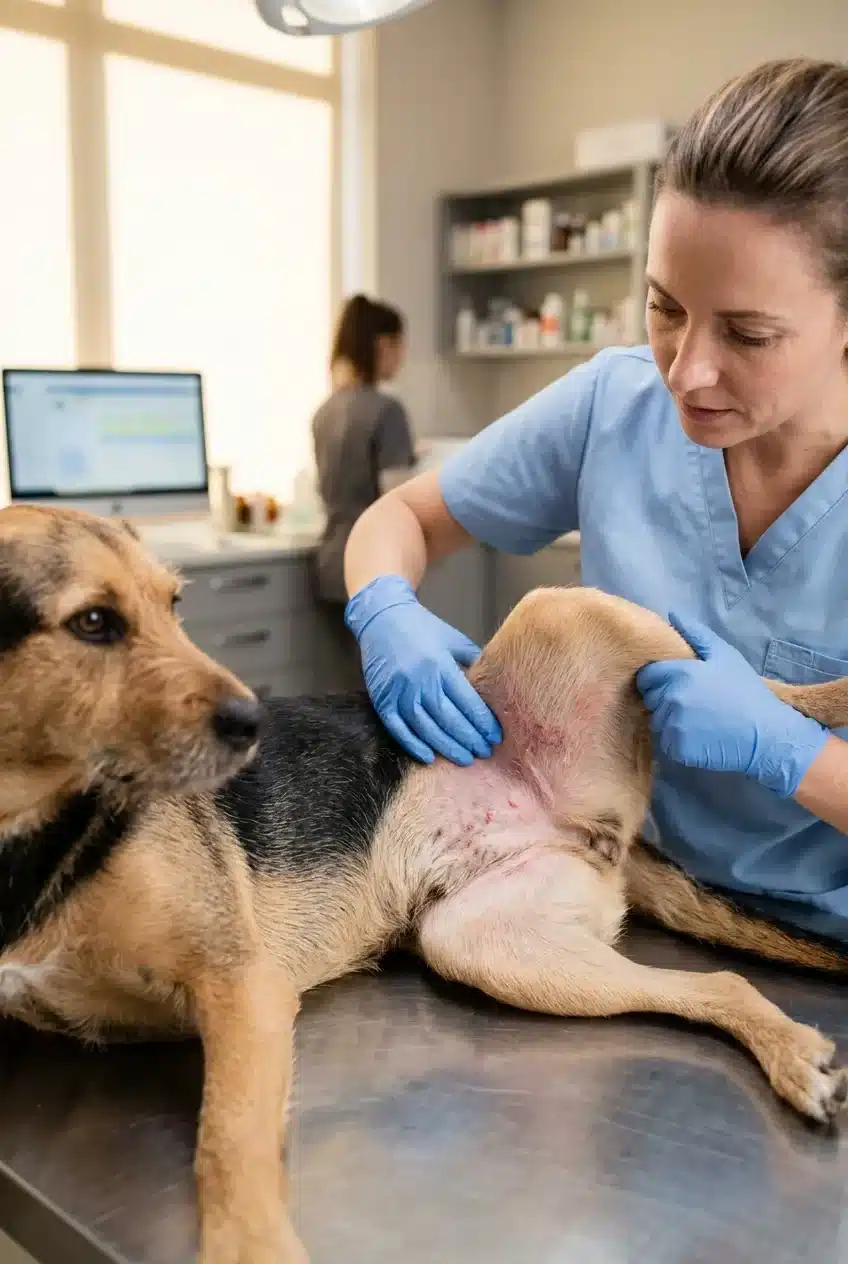
Here are the clearest signals that food — not the environment — is causing your dog’s skin problems:
1. The Rash Is Year-Round
Environmental allergies are often tied to seasons. If your dog’s skin is always inflamed no matter the time of year, and you have already ruled out household products, food is almost certainly the trigger.
Get Free Dog Health Tips!
Weekly guides on keeping your dog healthy & happy
🔒 No spam. Unsubscribe anytime.
2. Bathing Provides Only Temporary Relief
If medicated baths calm the skin for a day or two but the redness and itching always return, you are treating the symptom — not the cause. Food allergy rashes keep coming back because the trigger is ingested daily.
3. Ears Are Constantly Infected
This is one of the most overlooked signs. Chronic recurring ear infections — especially yeast-type infections — are strongly associated with food allergies in dogs. If your dog has had ear infections more than twice in a year, ask your vet to consider a food allergy workup.
4. The Belly, Groin, and Inner Thighs Are Most Affected
Food allergy rashes tend to concentrate on areas with thinner skin and less fur. If your dog’s worst areas are the underside of the body — belly, inner thighs, groin, and around the paws — that pattern strongly suggests a food allergy.
5. Steroids and Antihistamines Do Not Fully Work
If your vet has prescribed Benadryl or steroids and they only partially help or stop working over time, that is a red flag. Environmental allergies often respond well to antihistamines. Food allergies typically do not — the immune reaction is too deep.
6. The Dog Also Has Digestive Issues
Loose stools, frequent gas, or inconsistent bowel movements alongside skin problems is a strong indicator of food sensitivity. The gut and skin are connected — what irritates the digestive system often shows up on the skin too.
The 8-Week Hydrolyzed Protein Elimination Diet: The Gold Standard Test
If you suspect food allergy, the most reliable way to confirm it — and find the trigger — is an elimination diet. There is no blood test or skin test that reliably diagnoses food allergies in dogs. The elimination diet is the only proven method.
| What Is a Hydrolyzed Protein Diet? Hydrolyzed protein foods are made by breaking proteins down into molecules so small that the immune system cannot recognize them as allergens. This stops the allergic reaction and lets the skin heal. Common options include Hill’s z/d, Royal Canin Hydrolyzed Protein, and Purina Pro Plan HA. |
How to Do the 8-Week Elimination Diet
- Talk to your vet and get approval before starting.
- Switch your dog to ONLY the hydrolyzed protein food — no treats, no table scraps, no flavored medications.
- Maintain this strictly for 8 full weeks — even one bite of the old food can restart the allergic reaction.
- Track your dog’s symptoms in a daily journal — note itching, redness, ear condition, and stool quality.
- After 8 weeks, if symptoms have improved, slowly reintroduce single ingredients one at a time to identify the exact trigger.
- Once the trigger is confirmed, switch to a long-term diet that avoids that ingredient.
Most dogs show noticeable improvement within 4 to 6 weeks if food is the cause. Full resolution may take up to 12 weeks for severe cases.
What to Do Right Now: A Step-by-Step Action Plan
Step 1 — Stop the Over-Bathing
If you are bathing your dog more than once a week with dish soap or harsh shampoos, stop immediately. Over-washing destroys the skin’s protective barrier and worsens inflammation. Switch to a gentle, oatmeal-based or hypoallergenic shampoo and bathe no more than once every 2 weeks unless your vet specifically directs otherwise.
Step 2 — Book a Vet Appointment and Ask Specifically About Food Allergy
Go to your vet and say these exact words: ‘I would like to discuss doing an 8-week hydrolyzed protein elimination diet to rule out food allergy.’ Many vets default to environmental allergy diagnoses — being specific about what you want to explore will get faster results.
Step 3 — Start a Food and Symptom Journal
Before your vet appointment, start recording everything your dog eats and how their skin looks each day. Photos with timestamps are especially useful. This gives your vet real data to work with instead of guessing.
Step 4 — Check Your Dog’s Current Food Label
Look at the ingredient list on your dog’s food bag right now. If chicken, beef, or dairy is in the first five ingredients, there is a strong possibility that is the trigger. Even ‘chicken flavor’ or ‘chicken broth’ counts.
Step 5 — Consider a Prescription or Novel Protein Food
While you wait for your vet appointment, you can begin researching novel protein options — foods made from proteins your dog has never eaten before, such as duck, venison, rabbit, or kangaroo. These reduce the chance of an allergic reaction because the immune system has no prior exposure to them.
Breeds Most Prone to Food Allergies
While any dog can develop a food allergy, certain breeds are genetically predisposed to skin sensitivities and food reactions:
- Pit Bull Terriers and Pit Bull Mixes
- English Bulldogs and French Bulldogs
- Labrador and Golden Retrievers
- German Shepherds
- Boxers
- Cocker Spaniels
- Shih Tzus
- West Highland White Terriers
If your dog is one of these breeds and has chronic skin issues, food allergy should be at the top of your list — not the bottom.
Frequently Asked Questions
Can a dog suddenly develop a food allergy to food they have eaten for years?
Yes — and this is one of the most confusing aspects of food allergies. Dogs develop allergies through repeated exposure over time, not from the first bite. A dog that has eaten chicken for 3 years can suddenly become allergic to it. This is why a new rash can appear even when nothing in the environment has changed.
Is grain-free food better for dogs with skin allergies?
Not necessarily. Grain allergies are actually less common in dogs than protein allergies. Switching to grain-free food that still contains chicken or beef will not help if the protein is the trigger. Focus on the protein source, not the grain content.
How long does it take for a food allergy rash to clear up?
If you correctly identify and eliminate the allergen, you should see improvement within 4 to 6 weeks. Full skin healing can take up to 3 months depending on how severe the reaction was and whether there are secondary infections present.
Can I do the elimination diet without a vet?
You can, but it is not recommended. Your vet needs to rule out secondary infections like bacterial pyoderma or yeast overgrowth that may need treatment alongside the diet change. Doing the diet without treating infections first can give you false results.
Summary: Key Signs Your Dog Has a Food Allergy
- Year-round skin rash that does not improve with seasons
- Bathing gives only temporary relief
- Redness concentrated on belly, groin, inner thighs, ears, and paws
- Recurring ear infections
- Poor response to antihistamines or steroids
- Digestive issues alongside skin problems
- Worsening despite consistent environmental cleaning
| The Bottom Line If your dog’s skin rash keeps coming back despite all your efforts, stop looking at the environment and start looking at the food bowl. An 8-week hydrolyzed protein elimination diet — done strictly with your vet’s guidance — is the single most effective way to identify and solve the problem. Ask your vet about it at your next appointment. |