A 9 week old puppy should learn 2 to 3 commands at a time — no more. Their brains are developing fast, but attention spans are measured in seconds, not minutes.
You just brought home a new puppy and want to get training right from day one. That instinct is exactly right — week 9 is actually one of the best windows to start.
How Many Commands Should a 9 Week Old Puppy Learn at Once?

A 9 week old puppy can handle 2 to 3 simple commands introduced at once, practiced in short sessions of 3 to 5 minutes. Their brains are in a critical socialization window, making this an ideal time to start — but overloading them causes frustration and slows progress.
- Start with 2–3 commands maximum before adding new ones.
- Keep each training session under 5 minutes.
- Repeat each command 3–5 times per session.
- Wait until a command has an 80% success rate before adding a new one.
- Use high-value puppy training treats to hold attention.
- End every session on a success — even an easy one.
Why 9 Weeks Is a Special Age for Training

At 9 weeks, puppies are in the middle of what behaviorists call the primary socialization period, which runs roughly from 3 to 12 weeks of age. Research published by the American Veterinary Society of Animal Behavior confirms this window shapes lifelong behavior more than almost any other phase.
The brain is not fully developed, but it is highly plastic right now. New neural connections form quickly when learning is paired with positive reinforcement.
This is the best time to build habits — not just teach tricks.
Puppies at this age are also naturally curious and motivated by food. That combination makes short, reward-based sessions surprisingly effective even for very young dogs.
Attention Span: The Real Limiting Factor
A 9 week old puppy’s useful attention span in a training context is roughly 2 to 3 minutes before focus drops. After that, you are working against fatigue, not with learning.
Two short sessions per day outperform one long session every time at this age. Morning and early evening tend to work well, when puppies are alert after rest.
Which 3 Commands Should You Start With?
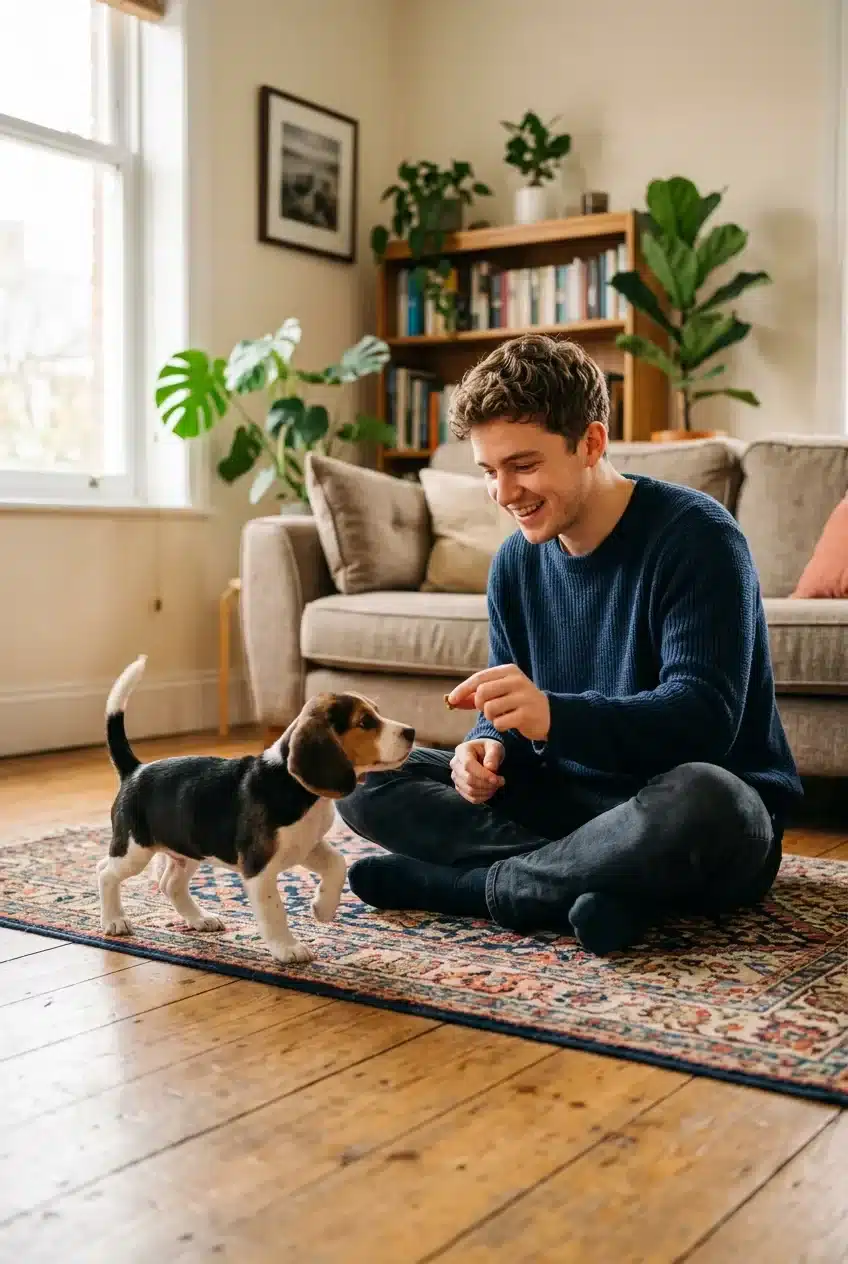
The three commands most recommended by certified professional dog trainers for puppies under 10 weeks are sit, name recognition, and come. These build the foundation for every other behavior you will teach later.
Get Free Dog Health Tips!
Weekly guides on keeping your dog healthy & happy
🔒 No spam. Unsubscribe anytime.
- Name recognition: Say the puppy’s name once, reward eye contact immediately. This is the gateway to every other command.
- Sit: Loft a treat slowly above the puppy’s nose. The natural response is to sit. Mark and reward the moment their rear hits the floor.
- Come: Call the puppy from 1–2 feet away, crouch down, and reward enthusiastically when they reach you. Keep the distance short at first.
These three are enough for the first 1 to 2 weeks. Adding stay or down too early dilutes focus and slows mastery of the basics.
If your puppy is a breed known for high trainability — such as a white standard poodle — you may find they progress through the basics faster, but the 2 to 3 command rule still applies.
How Long Does It Take to Master One Command?
Most 9 week old puppies need 3 to 7 days of consistent daily practice to reliably respond to a single new command in a low-distraction environment. That timeline stretches to 2 to 3 weeks before the behavior holds in distracting settings.
| Command | Average Days to 80% Reliability | Common Stumbling Block |
|---|---|---|
| Name recognition | 2–4 days | Repeating the name too many times |
| Sit | 3–5 days | Luring too high or too fast |
| Come | 5–7 days | Calling the puppy then scolding them |
| Down | 7–10 days | Starting before sit is solid |
| Stay | 10–14 days | Adding distance before duration |
Use the 80% benchmark as your signal. If your puppy gets it right 8 out of 10 tries in a calm room, you are ready to introduce something new.
Generalizing Commands to New Environments
A puppy that sits perfectly in the kitchen may look completely blank when asked to sit in the garden. This is normal — dogs learn contextually and need practice across locations.
Once a command is solid indoors, practice it in three or four different spots before calling it truly learned. Outdoors, near other dogs, or on different surfaces all count as new environments.
How to Structure a 9 Week Old Puppy Training Session
Building a simple routine makes training predictable for the puppy and easier for you to stay consistent. Here is a sequence that works at this age.
- Choose one quiet spot with minimal distractions — the same location each day helps the puppy settle faster.
- Prepare small, soft treats broken into pea-sized pieces. A treat pouch keeps rewards accessible and your hands free.
- Start with a known command — one the puppy already knows. This builds confidence before introducing anything new.
- Introduce the new command using a lure or a guided movement. Say the word once, reward the correct response immediately.
- Practice 3 to 5 repetitions of the new command, then return to the familiar one for 2 reps to finish strong.
- End the session after 3 to 5 minutes regardless of how well it is going. Always stop while the puppy is still engaged.
Success at this stage looks like: the puppy orienting toward you, attempting the behavior, and staying near you willingly. You do not need perfection.
Common Mistakes When Training a 9 Week Old Puppy
Avoiding these errors will save weeks of frustration.
- Teaching too many commands at once: Adding five or six commands in the first week overwhelms the puppy and leads to confusion about what is being asked. Stick to 2 to 3 until mastery.
- Sessions that run too long: A 15-minute session with a 9 week old is not thorough — it is counterproductive. Mental fatigue causes the puppy to disengage, and disengagement becomes a habit. Cap sessions at 5 minutes.
- Inconsistent cue words: Saying “sit,” “sit down,” and “sit, boy” interchangeably teaches the puppy nothing consistent. Pick one word per command and use it every time, with every family member.
- Skipping name recognition: Many owners jump straight to sit and come, but if the puppy does not reliably turn to their name, every other command starts at a disadvantage. Name recognition comes first.
- Punishing non-compliance: A 9 week old puppy that does not respond is usually confused or distracted, not defiant. Frustration or raised voices create anxiety around training. Reset, simplify, and reward any approximation of the right behavior.
Dogs that experience stress during early training are more likely to show avoidance behaviors later. The signs that a dog is struggling emotionally can be subtle and easy to miss at this age.
When to Add More Commands
Add a new command when two conditions are met: the existing commands hit 80% reliability in at least two different locations, and the puppy is actively engaged and focused during sessions.
Most puppies are ready to expand their vocabulary at around 10 to 12 weeks. By 12 weeks, a solid puppy can work with 5 to 6 known commands practiced in rotation.
According to the American Kennel Club, puppies as young as 7 to 8 weeks old are capable of learning basic commands — the key is keeping sessions short, positive, and consistent.
Breed also plays a role. Higher-energy or working breeds may need more mental stimulation earlier. If you are raising a litter or considering breed-specific traits, understanding how many puppies a dog can have and their developmental differences is worth knowing.
Rotating Commands Keeps Sessions Effective
Once your puppy knows 3 commands, rotate through all three in each session rather than drilling one repeatedly. Rotation builds fluency and keeps the puppy guessing in the best possible way.
A rotation session might look like: sit, come, name recognition, sit again, come again. Five to seven reps spread across three commands. Done in under 4 minutes.
Use a puppy clicker training kit to mark correct responses with precision — the click bridges the gap between the behavior and the reward, which speeds up learning at this age.
Keeping your puppy clean and comfortable also supports focus during training. A good puppy bathing routine reduces distractions from itchiness or discomfort, especially in small breeds. Using a gentle puppy shampoo helps keep skin healthy without irritating sensitive eyes or noses before training sessions.
For further guidance, the American Veterinary Society of Animal Behavior’s position statements on puppy socialization and positive reinforcement are a reliable, science-backed resource.
Frequently Asked Questions About How Many Commands Should a 9 Week Old Puppy Learn at Once
Can a 9 week old puppy learn sit and stay at the same time?
A 9 week old puppy can begin learning sit and stay at the same time, but stay should only be introduced after sit is reliable at least 80% of the time. Introducing both from day one typically delays mastery of both.
How long should a training session be for a 9 week old puppy?
Training sessions for a 9 week old puppy should last 3 to 5 minutes maximum. Two short sessions per day produce better results than one longer session because fatigue reduces retention at this age.
Is 9 weeks too young to start training?
Nine weeks is not too young to start training — it is actually an ideal age. The American Kennel Club states that puppies as young as 7 to 8 weeks can begin learning basic commands using positive reinforcement methods.
What is the easiest first command to teach a 9 week old puppy?
Name recognition is the easiest first command and the most foundational. Teaching a puppy to respond to their name before any other cue creates the attentional baseline needed for every command that follows.
Should all family members use the same commands?
Yes — all family members should use identical cue words for each command. Inconsistent language is one of the most common reasons puppies appear slow to learn when the training itself is actually the problem.
How do I know if my 9 week old puppy is learning too many commands at once?
Signs of overload include ignoring cues they previously knew, sniffing the ground during sessions, or repeatedly walking away. If you see these signs, drop back to one known command per session and rebuild from there.
Start Simple, Stay Consistent
The single most important takeaway: 2 to 3 commands at a time, in sessions of 3 to 5 minutes, practiced twice daily. That formula is more effective than any elaborate training program at this age.
Today, pick your three starter commands — name recognition, sit, and come — and run one 4-minute session. That is genuinely all it takes to start building a dog that listens.
The patience you invest at 9 weeks pays off for the next 10 to 15 years.