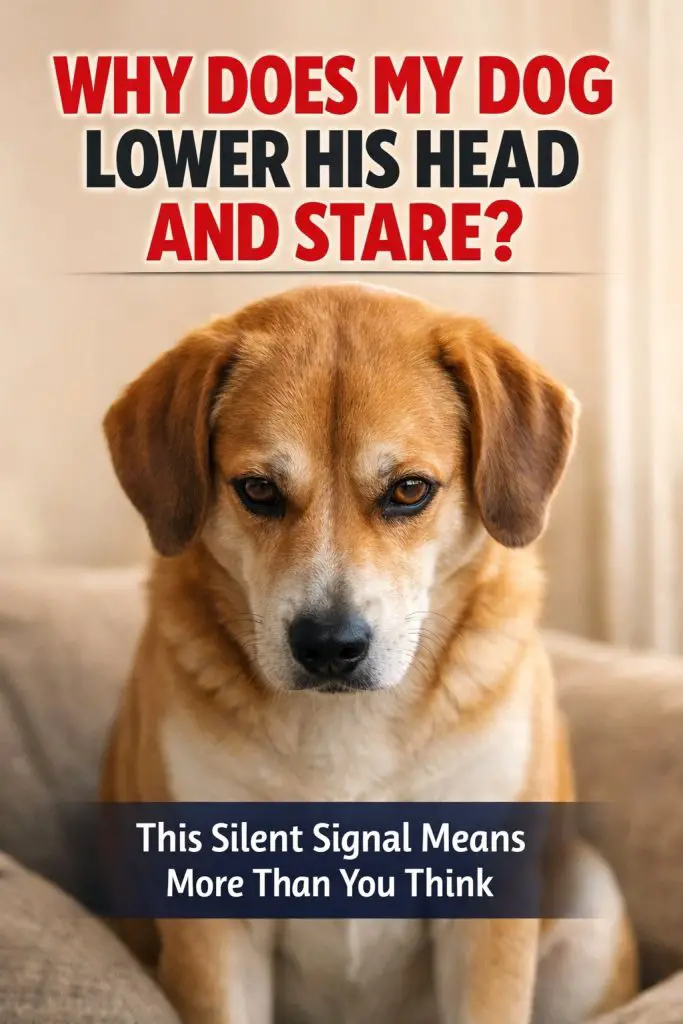
That Look That Stops You in Your Tracks
You’re sitting on the couch, scrolling your phone, when you feel it — that stare. You look up, and there’s your dog… head lowered, eyes locked on you, completely still. No barking. No tail wagging. Just intense, quiet focus.
And your brain immediately goes, “Okay… what does this mean?”
You’re not overthinking it. I’ve been there too — more than once — and that moment is exactly why I wanted to write this article. Dogs don’t waste energy on random body language. When a dog lowers his head and stares, he’s communicating something. The tricky part is figuring out what.
Let’s break this down together, calmly and clearly, so you can understand what your dog is trying to tell you — without panic, guilt, or guesswork.
Why Dogs Use Body Language More Than Sounds
Before we jump into meanings, it helps to understand how dogs communicate.
Dogs are masters of non-verbal signals. While barking gets attention, most emotional communication happens quietly — through posture, eye contact, and movement.
A lowered head combined with a stare is powerful because it mixes:
- Posture (head position)
- Eye contact
- Stillness
That combo almost always has a purpose.
The Most Common Reasons Your Dog Lowers His Head And Stares
1. He’s Feeling Unsure or Anxious
This is one of the most common reasons.
When dogs feel uncertain — about a situation, a person, or even your mood — they often lower their head as a calming or submissive signal. The stare isn’t aggressive; it’s cautious.
Signs this is anxiety-related:
- Ears pulled slightly back
- Mouth closed or tense
- Slow blinking or wide eyes
- Body looks still or stiff
IMO, this is often misunderstood as “guilt,” but dogs don’t process guilt the way humans do. They process emotional tension.
2. He’s Trying to Read You
Dogs are incredible observers. If your dog lowers his head and stares, he may be thinking:
“What’s about to happen?”
This happens often when:
- You’re quiet or upset
- You’re holding something unfamiliar
- A routine is about to change (walk, vet, food time)
Your dog is gathering information — watching your facial expressions, body posture, and tone.
This is not defiance. It’s attentiveness.
3. He’s Showing Submissive or Appeasing Behavior
In dog language, lowering the head can be a way of saying:
“I’m not a threat.”
This often shows up if:
- You raised your voice earlier
- You’re standing over him
- He thinks he may have done something wrong (from his perspective)
Key point:
Dogs don’t connect actions with past events like humans do. They react to your current energy, not what happened hours ago.
When Head Lowering And Staring Is NOT Aggression
This is important, so let’s be very clear.
A lowered head alone is rarely aggressive.
Aggression usually comes with:
- Hard, unblinking eyes
- Raised hackles
- Tense jaw or teeth showing
- Growling or freezing before lunging
If your dog’s body looks soft or unsure, you’re not looking at aggression — you’re looking at communication.
Could My Dog Be Asking for Something?
Yes — sometimes it’s that simple.
Dogs learn fast. If staring at you gets results, they’ll keep doing it.
Common “requests” behind the stare:
- Food or treats
- Walk time
- Attention or affection
- Help (toy stuck, door closed)
The lowered head adds politeness.
It’s like your dog saying, “Hey… excuse me… can you help?”
FYI: This behavior often becomes stronger if it’s been rewarded in the past — even accidentally.
The Role of Eye Contact in Dog Communication
Eye contact means something very different in the dog world.
Soft Eye Contact
- Relaxed eyes
- Occasional blinking
- Calm facial muscles
👉 This usually means connection or curiosity.
Hard Eye Contact
- Wide, unblinking stare
- Tense face
- Still body
👉 This signals stress, fear, or challenge — not necessarily aggression, but emotional overload.
A lowered head with soft eyes is generally safe and communicative. A lowered head with hard eyes means your dog needs space.
Is My Dog Afraid of Me?
This question comes up a lot — and it’s an emotional one.
Short answer? Not usually.
Longer answer: Your dog may be reacting to:
- Your tone of voice
- Sudden movements
- Stress you’re carrying
- Past experiences (not always with you)
Dogs are emotional sponges. Even subtle tension can trigger submissive or watchful behavior.
What helps immediately:
- Soft voice
- Sideways posture (don’t loom)
- Slow movements
- Calm breathing (yes, really)
Puppy vs Adult Dog — Does Age Matter?
Absolutely.
Puppies
- Still learning body language
- Often stare to understand reactions
- Lower head when unsure or overwhelmed
Adult Dogs
- Behavior is more intentional
- Often tied to learned responses
- Stronger emotional associations
Senior Dogs
- May stare due to confusion
- Vision or hearing changes
- Cognitive decline (in some cases)
If this behavior is new in an older dog, it’s worth paying attention.
When You Should Be Concerned
Most of the time, head lowering and staring is normal. But there are moments when you should dig deeper.
Watch closely if it’s paired with:
- Sudden behavior changes
- Withdrawal or hiding
- Loss of appetite
- Whining or pacing
- Head tilt or imbalance
In rare cases, prolonged staring can be linked to:
- Pain or discomfort
- Neurological issues
- Vision problems
If your gut says something feels off, trust it.
How You Should Respond (And What to Avoid)
What TO Do:
- Stay calm and relaxed
- Speak softly
- Kneel instead of standing over your dog
- Give space if he seems unsure
What NOT To Do:
- Don’t stare back intensely
- Don’t scold
- Don’t force interaction
- Don’t assume “dominance” issues
Dogs respond to safety, not control.
Can Training Affect This Behavior?
Yes — both positively and negatively.
If a dog has learned that:
- Staring = reward
- Lowered head = avoids punishment
Then the behavior sticks.
Balanced training focuses on:
- Clear cues
- Consistent responses
- Emotional safety
A confident dog has less need to communicate through tension-based signals.
The Emotional Takeaway Most Owners Miss
Here’s the big picture moment.
Your dog lowering his head and staring isn’t about manipulation, dominance, or guilt.
It’s about connection.
Your dog is checking in. He’s asking:
- “Are you okay?”
- “Am I safe?”
- “What happens next?”
Once you see it that way, the behavior feels less alarming — and more meaningful.
Conclusion: Listening Without Words
So, why does your dog lower his head and stare?
Because dogs speak in posture and silence, not sentences. That look is your dog communicating uncertainty, attention, emotion, or trust — sometimes all at once.
When you respond with calm understanding instead of worry, you strengthen your bond in ways treats and commands never could.
Next time it happens, pause. Breathe. Look at the whole picture — not just the stare.
Your dog isn’t judging you.
He’s talking to you — in the only language he knows.
And now, you know how to listen.